
1
Display Mode
TN / HTN / STN / FSTN, positive or negative mode — selected for contrast, viewing, and cost.
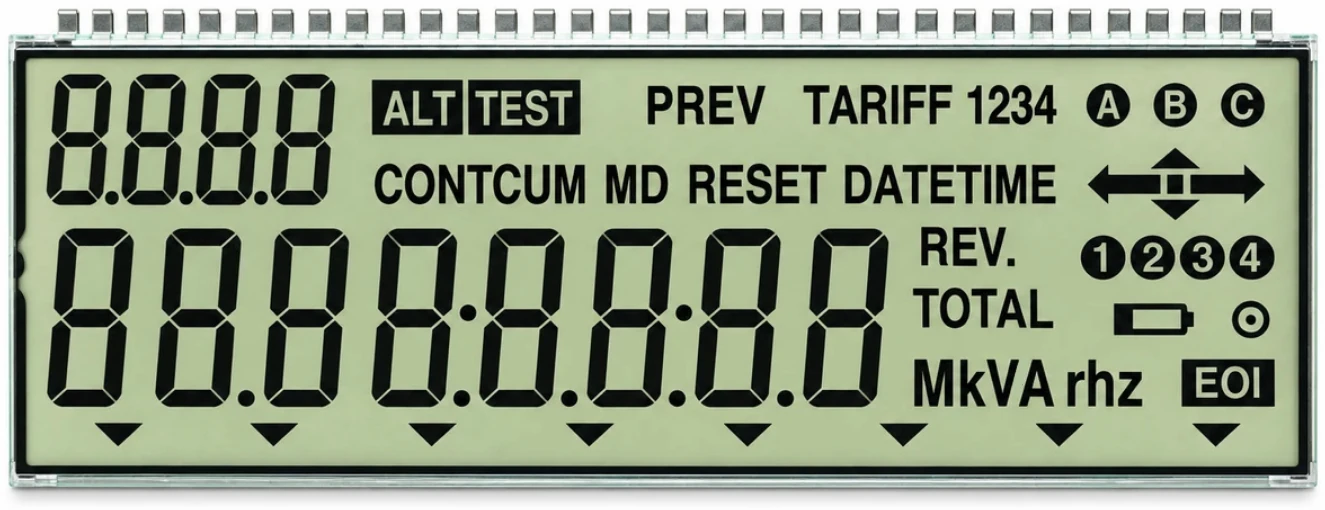
Application-specific monochrome LCDs developed around your required layout, icons, viewing direction, display mode, polarizer, operating conditions and backlight.
Monochrome LCDs are used in energy meters, measuring instruments, control panels and industrial electronics where clear readability, low power consumption and stable long-term operation are important.
Each display is developed to an approved specification with application-specific digits, icons, viewing direction, display mode and polarizer options. Polarizer application, pin assembly, UV curing, backlight matching, electrical testing and final inspection are carried out at Sartech’s facility.
Options are confirmed in writing for each project before sampling.
| Parameter | Available options |
|---|---|
| Display Mode | TN / HTN / STN / FSTN; Positive or Negative |
| Viewing Direction | 3H / 6H / 9H / 12H or Customised |
| Operating Temperature | Standard / Wide / Ultra-Wide Optional |
| Polarizer Type | Transmissive / Transflective / Reflective |
| Surface Treatment | Anti-Glare / Anti-Reflective / Anti-UV |
| Structure Option | LCD Panel / COB Module / COG Module |
| Backlight Option | White / Yellow-Green / Blue / Red / Green / Amber / RGB / Custom |
Each parameter is selected to suit the application, viewing conditions, and electrical design.
TN / HTN / STN / FSTN, positive or negative mode — selected for contrast, viewing, and cost.
3H / 6H / 9H / 12H or customised to the mounting position and the user’s line of sight.
Transmissive, transflective, or reflective — chosen for ambient light and backlight requirements.
Standard, wide, or ultra-wide temperature options for industrial and outdoor environments.
Anti-glare, anti-reflective, and anti-UV treatments for readability and long-term durability.
LCD panel, COB, or COG module — with custom segments, icons, logos, pin configuration, outline dimensions, and viewing area.
Send a drawing, sample, or a description of the display you need.
Our engineering team reviews the layout, dimensions, and operating conditions.
Display mode, viewing direction, polarizer, backlight, and interface are agreed in writing.
Samples are developed to the confirmed specification.
You evaluate the sample in the product and confirm approval.
Approved parts move to production with inspection and batch records.
Glass, polarizer and components are inspected before they enter production.
Controlled polarizer application and pin attachment with UV-curing control.
Automated optical inspection (AOI), standalone electrical testing and segment-response checking.
Visual inspection against the approved sample, final inspection, batch records and traceability.
Sharing the following information helps our engineering team review the requirement accurately.
Share your drawing, dimensions and operating requirements with our engineering team.